_edited.jpg)
How to Avoid Leaving Millions on the Table When Selling Your Business

The complete guide to accepting the first offer, negotiating alone, and bringing only a T-Rex to a billion-dollar conversation
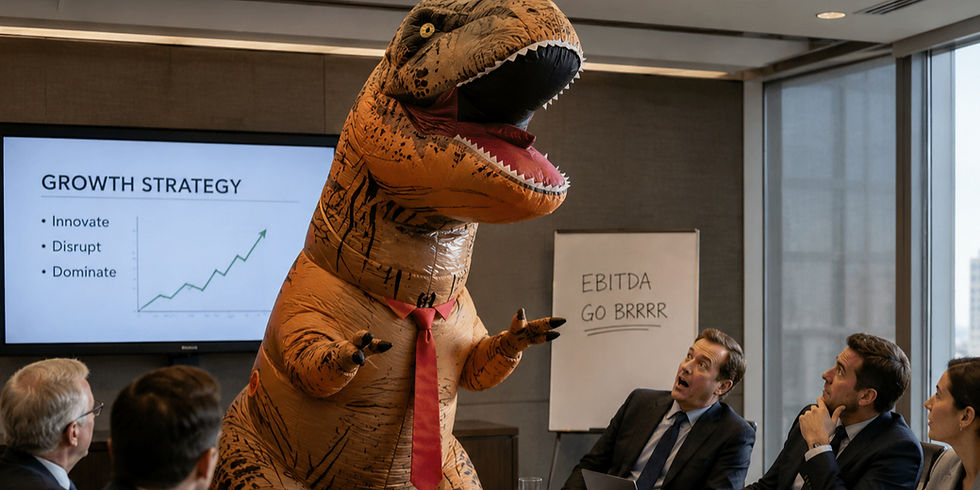
Selling a business is one of the biggest decisions an entrepreneur will ever make. Years of sacrifice, sleepless nights, missed family dinners, and questionable decisions involving expensive coffee machines all lead to one moment:
The exit. The magical moment when an entrepreneur discovers that the company they spent decades building can be valued by someone who has never met their employees, never visited their facility, and somehow knows exactly what it is worth after a 45-minute Zoom call.
And when that moment arrives, many business owners make a terrible mistake.
They get excited. Someone emails them. Someone says, “We love what you’ve built.” Someone from a private equity firm sends a message that begins with, “We’ve been following your incredible journey.” Which is corporate language for: “We noticed your company exists and would like to discuss how we can become very wealthy together.”
Congratulations. You have officially entered the most dangerous phase of business ownership:
The part where someone compliments you right before trying to buy your life’s work for the price of a moderately expensive sports car.
Rule #1: Always Accept the First Offer Because Surely Nobody Else Wants Your Company
A sophisticated buyer may spend months analyzing your business.
You should spend approximately seven minutes.
Open the email. See a big number. Immediately announce to your spouse:
“Pack your bags. We’re rich.”
Ignore the fact that your company has taken 20 years to build. Ignore the fact that other buyers might exist. Ignore the possibility that someone else might pay more.
Competition? Negotiation? Market exposure?
Those are things for people who enjoy unnecessary complications like "getting the highest possible price."
Real entrepreneurs accept the first offer because nothing says “successful exit strategy” like leaving millions behind and later saying:
“Well, at least they were really nice during the meeting.”
Rule #2: Never Hire an Expert Because You Watched Three YouTube Videos
Why pay professionals who understand mergers and acquisitions when you have:
A calculator app
A LinkedIn account
A cousin who once sold a used boat
Investment bankers have spent years understanding valuations, deal structures, buyer psychology, and negotiation.
But have they ever watched a 14-minute video titled:
“10 Things Rich People Don’t Want You To Know About Selling Your Company?”
Exactly.
Congratulations. You are now qualified to negotiate against people who do this every Tuesday before lunch and have already bought 14 companies while you were watching that video.
Rule #3: Make Sure You Meet the Buyer Wearing the Most Appropriate Outfit Possible
First impressions matter.
When meeting a potential buyer, do not wear a professional suit.
That screams “I take this seriously.”
Instead, arrive wearing an inflatable dinosaur costume.
Why?
Because billion-dollar negotiations are about confidence. Nothing says, “I understand EBITDA multiples” like a six-foot inflatable Tyrannosaurus Rex squeezing into a conference room chair while explaining your company's growth strategy while your tiny plastic arms fail to point at the presentation screen.
If the buyer still wants to acquire your company after seeing you roar your opening presentation, you know they are committed.
Rule #4: Keep All Your Valuable Information Locked Away
Buyers love uncertainty.
Make sure they have no idea:
Who your customers are
Why your margins are strong
What makes your company special
Where future growth comes from
Mystery creates value.
That’s why people pay more for businesses they understand less.
In fact, the best strategy is to remove all information and just tell buyers:
“Trust me. The numbers are somewhere.”
Rule #5: Negotiate Alone Against a Team of Professionals
The buyer arrives with:
Lawyers
Accountants
Analysts
Industry experts
Acquisition specialists
You arrive with:
Your optimism
A folder labeled “Important Stuff”
The memory of every late night you worked
A giant inflatable T-Rex costume because "intimidation is all about presence"
Fair fight.
It’s basically a boxing match between a professional heavyweight and someone who watched Rocky once.
Selling Your Business: The Biggest Mistake: Thinking an Offer Means You Won
An offer feels like victory. It feels like someone finally recognized your hard work. But an offer is not the finish line.
It’s the beginning of a negotiation.
The buyer’s goal is to purchase your company. Your goal is to make sure you don’t accidentally donate a few million dollars while thanking them for the opportunity.
The smartest sellers create competition. They understand their value.
They bring in people who know how to navigate the process.
Because the biggest difference between a good exit and a great exit is often simple:
A good seller gets an offer.
A great seller makes buyers fight over the privilege of buying them.
And remember:
If you’re selling a company worth millions and you show up to negotiations dressed as an inflatable dinosaur, at least make sure your investment banker knows how to explain it as “an innovative leadership strategy.”
Because that’s what entrepreneurs do. They turn questionable decisions into “vision.”
And if the deal falls apart, at least you’ll know the buyer wasn’t serious. No serious buyer walks away from a company just because the CEO negotiated wearing a T-Rex costume.
Unless the T-Rex starts asking for an earn-out, a board seat, and three years of consulting fees. Then everyone has concerns.
Selling Your Business #businessadvice #howtosell #negoiate #winning #sell #hardhatkings



Comments